How Race, Class, and Gender Intersect to Shape Exposure to Environmental Hazards
Environmental hazards do not affect every person in the same way. Where someone lives and works, the resources available to them, and whether decision-makers take their concerns seriously can all shape exposure and its consequences. In environmental justice, intersectionality helps explain how race, class, and gender operate together, rather than as separate influences.
This perspective shifts the question from whether a community faces pollution to who within that community encounters it most, who can reduce contact, and who has the power to influence decisions. It also avoids treating any racial, economic, or gender group as having one shared experience.
What intersectionality means in environmental justice
Intersectionality in environmental justice describes how overlapping social positions and systems of power shape people’s exposure to hazards and access to protection. Race, socioeconomic status, and gender can combine with housing, work, health, and political influence to produce different experiences, even in the same place.
The term is associated with legal scholar Kimberlé Crenshaw’s work on overlapping forms of discrimination. Applied to environmental justice, it helps show how racism, economic inequality, and gendered expectations can shape where hazards are located, who is exposed, and whose needs guide a response.
Consider a neighborhood near a busy road or industrial facility. Residents may share the same air, but their options can differ. A renter with limited income may be unable to move or make home repairs; a homeowner may have more control over insulation or ventilation. A shift worker may spend long hours near a source of pollution, while a caregiver may have less flexibility to attend public meetings or reach a clinic.
Intersectionality is a way to analyze systems, not a checklist of identities. It asks how policies and everyday conditions interact. Race alone does not predict an individual’s experience, and neither does income or gender. Their combined effects depend on local history, housing and land-use decisions, employment conditions, and access to resources.
How social conditions influence exposure
Social conditions influence environmental hazard exposure by shaping where people live, what work they do, and how much control they have over their surroundings. Housing, neighborhood location, and occupational exposure can create repeated contact with hazards while limiting practical ways to avoid them.
Housing and land use are closely connected. Zoning, past planning decisions, housing discrimination, and uneven investment can influence which neighborhoods sit near industrial sites, freight routes, or other sources of pollution. These patterns are not the result of individual choices alone. Rent, housing availability, and discrimination can narrow people’s options, while renters may have little authority to repair dampness, improve ventilation, or address other conditions inside a home.
Exposure also follows people to work. Some workers spend time around dust, chemicals, heat, vehicle emissions, or other workplace hazards. Their risk depends on the task, duration, protective equipment, training, and power to report unsafe conditions. Workers with insecure jobs may feel less able to refuse hazardous work or request adjustments. These circumstances can overlap with race, gender, and socioeconomic status, but they vary widely by occupation and employer.
Neighborhood conditions can add to workplace exposure. For example, someone who works outdoors near traffic and lives beside a major road may encounter pollution in both settings. That does not mean every person in the area faces the same dose: time spent indoors, building conditions, mobility, and health all matter. Exposure reflects both the hazard and a person’s ability to avoid or reduce contact.
- Housing: Rent, housing quality, and decision-making power affect protection at home.
- Neighborhood: Land use, transport routes, and local infrastructure shape nearby conditions.
- Work: Job tasks, safety practices, and bargaining power influence occupational exposure.
Why impacts and responses differ
People exposed to similar environmental hazards can experience different impacts because health, resources, responsibilities, and access to support differ. The ability to prepare, seek care, take time off, or relocate can affect how well someone responds to an environmental event or ongoing exposure.
Existing health conditions may make some people more vulnerable to a particular hazard, while age, disability, and access to health care can affect diagnosis and recovery. These are not simple effects of race, class, or gender; they are shaped by factors such as medical access, living conditions, and treatment by institutions. A careful analysis looks at actual conditions rather than assuming risk from a person’s identity.
Money and time also matter. A household with savings may be able to stay elsewhere during a local emergency, replace damaged belongings, or travel for care. A household living paycheck to paycheck may have fewer choices. Caregiving responsibilities can add pressure: a person may need to protect children, older relatives, or someone with a disability while also managing work and housing demands. Gender norms can influence who performs unpaid care, but these responsibilities vary among households and communities.
Support systems can reduce harm, yet access is uneven. Information may not reach people who speak different languages, work irregular shifts, or lack reliable internet. Emergency assistance may require documents, transport, or time away from work. Resilience should not be measured only by whether people endure a hazard. It also depends on whether institutions provide timely information, health services, safe housing, income support, and meaningful choices.
How environmental decisions can reinforce inequity
Environmental decisions can reinforce inequity when planning, regulation, or consultation excludes affected people or discounts their evidence. A public process may be formally open while remaining difficult to access for residents with limited time, transport, language support, or trust in agencies.
Land-use decisions and permits can affect where facilities are built and how cumulative impacts are considered. If agencies examine one project at a time, they may miss the combined burden from traffic, industrial activity, and poor housing conditions. Enforcement matters too: a rule offers limited protection if complaints go unanswered or monitoring is too sparse to identify problems.
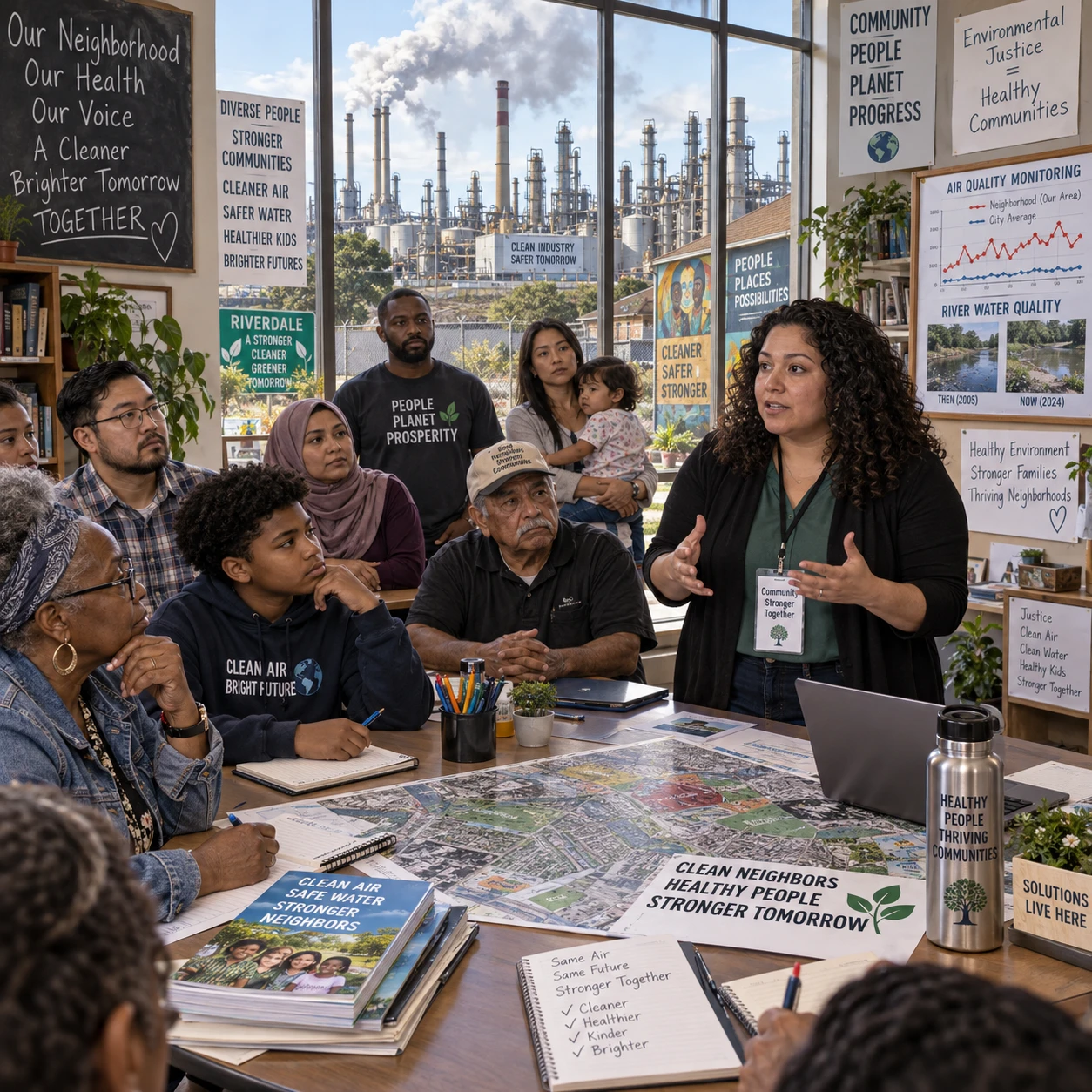
Community participation is more than a comment period. Residents often hold detailed knowledge about daily conditions, such as when odors occur, which routes children use, or how flooding affects particular blocks. That knowledge can identify questions that a site visit or regional dataset misses. Still, inviting people to speak is not enough if officials do not explain how input changes a decision.
Participation can also be uneven within a community. Homeowners, renters, workers, caregivers, and people who do not speak the dominant language may face different barriers. Decision-makers should ask who is missing from the room and whether meeting times, formats, translation, and compensation make involvement possible. Community input should inform choices early, before major options have already been decided.
What a more equitable approach looks like
A more equitable environmental approach combines better data, meaningful community participation, and practical protections for people facing overlapping disadvantages. It assesses both the distribution of hazards and the distribution of resources that help people prevent or recover from harm.
Agencies, planners, and community organizations can use a simple four-part check: map, listen, compare, and act. Map nearby hazards alongside housing, health, and transport conditions. Listen to residents and workers through accessible, ongoing engagement. Compare who receives benefits and who bears costs, including cumulative impacts. Then act with measures that can be tracked and revised.
- Collect and share relevant environmental and health data while explaining uncertainty and limits.
- Offer translated materials, varied meeting times, accessible locations, and remote options where useful.
- Include renters, workers, caregivers, young people, and residents with disabilities in planning.
- Evaluate cumulative exposure and consider alternatives before approving projects or land-use changes.
- Track enforcement, mitigation, and community feedback, and report what changed as a result.
For a practical policy reference, the U.S. Environmental Protection Agency’s environmental justice resources describe federal work on fair treatment and meaningful involvement. Such frameworks can support local decisions, but they do not replace community leadership or guarantee a particular outcome.
Equity does not mean assuming that every neighborhood wants the same solution. Residents may prioritize emissions monitoring, safer housing, job protections, health services, or investment in local infrastructure. A credible process makes trade-offs visible, explains who will benefit, and gives affected people a real role in choosing among options.
Frequently asked questions
What does intersectionality mean in environmental justice? It means examining how factors such as race, income, and gender interact with systems and conditions to shape exposure, health impacts, and access to protection.
How can race, class, and gender affect exposure to hazards? They can influence housing choices, neighborhood conditions, job opportunities, decision-making power, and access to health care or emergency support. The effects depend on context and do not determine every individual’s experience.
Why might people in the same community experience different impacts? Residents can differ in health, housing quality, work schedules, caregiving responsibilities, mobility, and resources. Those differences affect both exposure and the ability to respond.
How can communities advance more equitable environmental decisions? Communities can seek accessible consultation early in the process, bring local knowledge into planning, request clear data and explanations, and monitor whether agencies follow through on protections and commitments.